Wednesday, September 10, 2025

INSPECTOR IMANISHI INVESTIGATES by SEICHO MATSUMOTO

The investigation itself is superbly plotted, but what captures your attention is the depiction of Japan in the 1960s. Japan is rebuilding after WW-2. Tokyo is on its way to becoming a modern city. The middle-class is growing. There is austerity, determination, and also poverty in the interiors. Infrastructure is developing rapidly, as one can see in the extensive rail network. Western influence is palpable in Japanese culture, in the arts and music.


Saturday, September 6, 2025

Stars from Another Sky - Saadat Hasan Manto's book on the Bombay Film World of the 1940s

This book, ‘Stars from Another Sky,’ was first released in 1998, and I must have read it sometime between 1999 and 2000.  I was still at CIEFL, trying to complete my thesis.  I had read Manto’s short stories earlier, in Khalid Hasan’s excellent English translation (Kingdom’s End and Other Stories).  Some of these stories are so seared into your soul that you cannot forget them.  I was looking for something to read in between writing my thesis chapters.  I don’t remember where I was searching in the CIEFL library; I was not particularly looking to read more Manto stories, but somehow stumbled upon this book.  I was intrigued and happy to find out that this book contained profiles by Manto on the people (actors and others) of the Bombay film world of the 1940s.  The only names that I could clearly recognise were Ashok Kumar and Nargis, and Noor Jehan (more as a singer) and Shyam, distantly.  Manto’s brief bio in the book says, “In a literary, journalistic, radio-scripting and film-writing career spread over more than two decades, he produced twenty-two collections of short stories, one novel, five collections of radio plays, three collections of essays, two collections of personal sketches and many scripts for films.”  


Most of us usually think of Manto only as a short story writer, and his short stories are what we encounter for the first time when we start reading Manto.  That he was involved with the film world and wrote articles about film-people was a revelation to me.  I read the book with great interest and was taken into a different world.  I couldn’t find a copy of this book to buy then.  And then, this edition (the second) came out in 2010 and I was delighted to purchase a copy for myself and read all the articles once again.  This edition has a charming introduction by Jerry Pinto.  Pinto says ... “But then Manto tells us again and again of his role in the creation of that world.  He translated film pamphlets into Urdu, he wrote film scripts for several studios and even appeared in front of the camera despite acute stage fright.  His involvement with cinema did not allow him the highbrowed tone of the critic.  In fact, these pieces often do not deal very much with the work of the person who is being profiled ... It is as if Manto was not writing about the film world, no, not even about film stars from another sky; he was writing about himself.”     


Friday, July 4, 2025

ON THE SANDS OF CAVELOSSIM BEACH

 ON THE SANDS OF CAVELOSSIM BEACH 


And, here we are 

And now that we are here

Let’s sit for a while

Rest our limbs and mind

And later 

We’ll see what we can do here

There’s lots we can do

But

Let’s sit for a while

Or

Let’s sit for a bit longer 

It’s been a long time

Since

We sat together 


We have journeyed on 

Land water and air 

We have seen all the forts

Gardens temples churches 

Palaces museums and statues

We have hurried from one 

To another in a mad rush

Heads hazy 

Eyes ablur 


We are here now

Let’s sit for a while

Rest our limbs and mind

Let’s sit for a while longer 

Wait for the sun to set

The sky to turn dark-blue

The waves to sparkle 

The ship-lights to come alive 


SJR


Tuesday, July 1, 2025

THE PENGUIN BOOK OF POEMS ON THE INDIAN CITY ... My translations of K V Tirumalesh's Hyderabad Poems in this anthology ...

This monumental anthology, THE PENGUIN BOOK OF POEMS ON THE INDIAN CITY, edited by Bilal Moin, arrived at my door some days ago ... and I was elated ... to say the least ...


On 13th August last year, I received a mail that surprised me. It was a mail from Mr Bilal Moin. He introduced himself and told me that he is editing an anthology of poems on the Indian city to be published by Penguin Random House. He told me that he found my English translations of one of Kannada’s foremost modernist poets, K. V. Tirumalesh’s Hyderabad Poems on my blog and enjoyed reading them. He then sought my permission to reprint two of my translations in this anthology. 


For some odd reason I got hooked to Tirumalesh Sir’s Hyderabad poems that I found in his collections Mukhamukhi (1978) and Avadha (1986) and proceeded to translate them into English. This started around eight years ago. I took this up as my personal project. After mining these two collections, I started searching his other collections and found that there are a number of Hyderabad ‘fragments’ in his two epic style narratives – Akshaya Kavya (2010) and Avyaya Kavya (2019). I translated all of them, and enjoyed doing it. Tirumalesh Sir became a Hyderabadi long time ago, and I became one subsequently. I enjoyed revisiting a lot of spaces that he alludes to in his poems. 


And then, I created a blog and posted my translations online. I tried to create some ‘publicity’ too. My Hyderabad-Kannadiga friends, Nikhila and Tharakeshwar Tharakeshwar Vb, helped me in disseminating these translations. It was at an annual literary-cultural event in December 2018 that Nikhila had organized in memory of her father that I did a reading of some of these poems for the first time. Then, Tharakeshwar got twelve of these translations published in ‘Caesurae’ and ‘Maidaanam.’ ‘Muse India’ published three more translations. Then last year, one poem found its way into an English textbook of Kuvempu University, through the good offices of another friend, Prof Siraj Ahmed.


And then, out of the blue, I get Bilal Moin’s mail, and I was so happy. These poem-translations have been in the public domain for so many years now, and to have them discovered like this gave me a lot of satisfaction. I don’t know how Tirumalesh Sir would have felt about all this. He was a forthright person, and probably would have shrugged his shoulders and smiled. That’s what I would like to fondly believe. I received a lot of support from Tirumalesh Sir’s family and their permission to translate and publish his poems. 

Two Hyderabad poems by Tirumalesh, ‘On the Arts College Road’ (Arts Collegina Haadiyalli ಅರ್ಟ್ಸ್ ಕಾಲೇಜಿನಹಾದಿಯಲ್ಲಿ) from ‘Mukhamukhi’ and ‘Pesticide Sabi,’ (Keetanashaka Sabi ಕೀಟನಾಶಕ ಸಾಬಿ) a Hyderabad fragment from ‘Avyaya Kavya,’ are included in this collection. 


And, significantly, ‘Pesticide Sabi’ also features in the ‘introduction’ and the editor notes the use of the word ‘Sabi’ reflecting the rich complexities of the Kannada language and the translator having to navigate these layers of meanings to create the same cultural weight and depth in English as in the original. 


I would like to wholeheartedly thank Mr Bilal Moin for discovering these poems and for reaching out to me. I know him only through the mails we exchanged, and he came across as a warm and earnest person. This anthology is a massive door-stopper of a book counting a stupendous 1072 pages and containing 375 poems. This anthology contains a whole range of voices, from the classical to the contemporary, and it is certain to give its readers hours of enchantment as the poems take them through the thoroughfares and lanes and bylanes and sights and sounds and smells of the Indian city ... and thoughts and feelings ... 


Take a bow, Bilal Moin ... on undertaking this epic task and bringing out a beautiful work of art 😀👌🌺 ... 


Tuesday, June 17, 2025

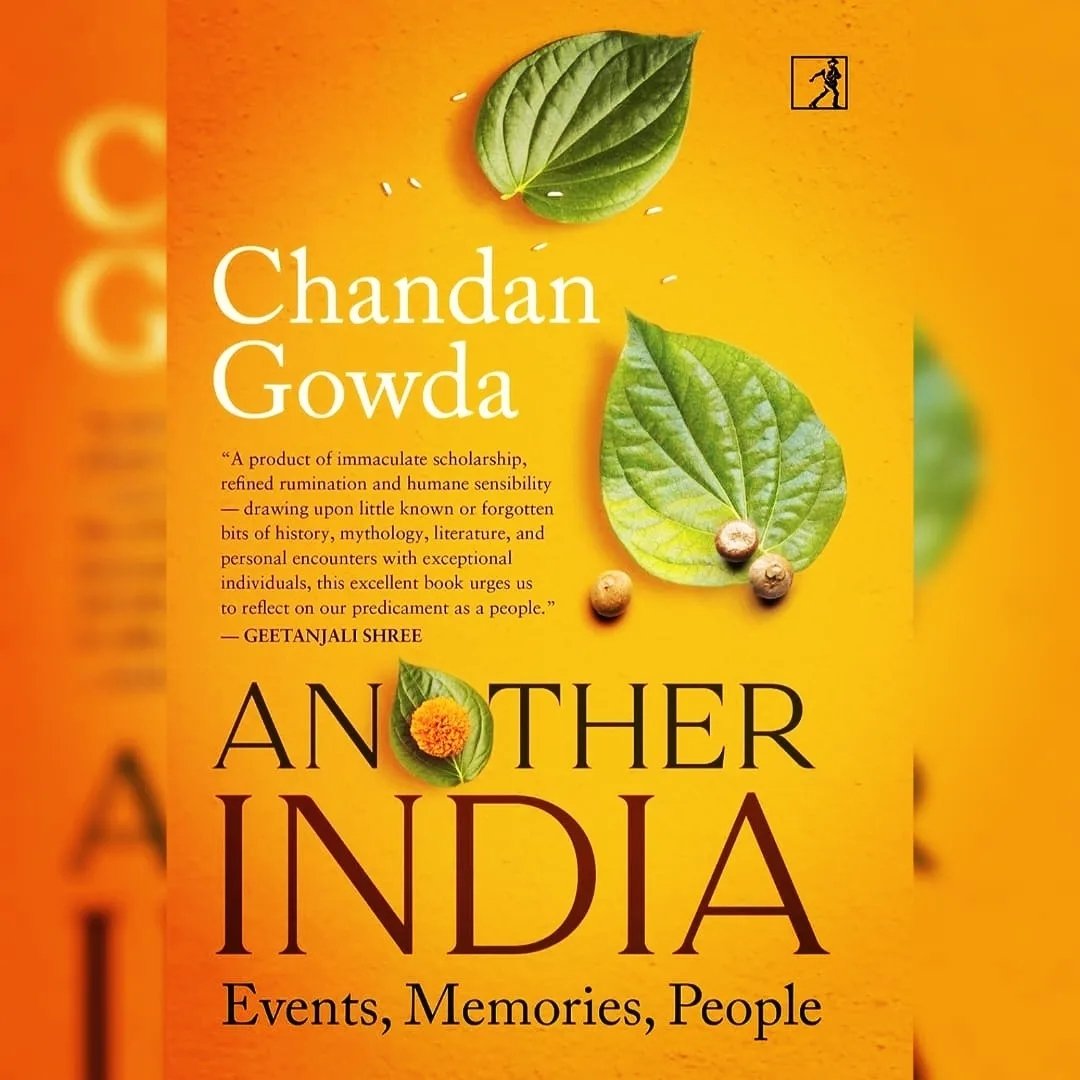
Chandan Gowda's "Another India: Events, Memories, People"

11 June 2025


This book, Chandan Gowda's 'Another India: Events, Memories, People,' has been living in the ‘cart’ for so many days and four days ago, I pushed the button, and it came home yesterday. I started reading straightaway and by evening I had read more than half of the essays.

The first essay, ‘A People without a Stereotype,’ caught my attention immediately. As a nomad, having lived in 6 different states and being married to a person having stakes in Bihar and Bengal, this question had always tickled me. The term ‘Kannadiga’ was met with some kind of incomprehension most of the times. I used to feel ‘Kannadigas’ always flew under the radar. My father was posted in Sultanpur, UP, when P V Narasimha Rao became the PM. His UP-based colleagues came to congratulate him, ‘Raosaab, aapka aadmi PM ban gaya’ ... when my father explained to them that the PM is a Telugu and that he is a Kannadiga and that there is a difference, it didn’t make any difference. Aap sab log Madrasi hain na ...

As Chandan says, we never travelled and settled elsewhere in large numbers to create this stereotype. Tulu speakers from Dakshina Kannada have settled in large numbers in Mumbai, Pune and other cities. They are called ‘Anna’-s there. But Kannadigas don’t have a pan-Indian referent like Mallu, Bong, Thambi, Golti, Gujju, Bhaiyya, and so on. I remember a discussion some of us had in the CIEFL hostel dining hall a long time ago, “hey, what are you people called? We are called ‘Mallus’ ... she is a ‘Bong’” ... “I don’t know ... nobody notices us I think ... you should find us a name,” I said. We tried different names and the one which came close to acceptance was ‘Kannus.’ But that didn’t take off and the discussion remained there. Chandan’s essay made me think about this topic again. 
For a nomadic Kannadiga like me, this book is a treasure trove of stories, ideas and information. The essays filled a number of gaps in my understanding of Kannada culture, literature, local myths, urban myths, politics, popular culture, etc. Chandan Gowda has employed an engaging style, interlaced with wit and humour, and at the same time one can perceive a solid intellect working behind the scenes to make it all happen.